Quang Phu Cau Incense Village
Having existed alongside the capital city for nearly a hundred years, Quang Phu Cau Incense Village is one of Hanoi’s most beloved check-in spots. Through the ups and downs of time, the people here have persevered, remaining dedicated to the incense stick making craft passed down through generations. More than just a livelihood for generations of local people, Quang Phu Cau Incense Village is also a unique and distinctive feature in the outskirts of the capital.
Continue your artisan journey
- Bat Trang pottery village
- Chuong conical hat village
- Chuon Ngo mother-of-pearl inlay village
- Ha Thai lacquer village
1. How Far from Hanoi to Incense Village
Quang Phu Cau Incense Village, also known as the incense village, is a quite famous check-in destination located on the outskirts of Hanoi, about 35 km from the city center. The incense stick craft village belongs to Quang Phu Cau commune, Ung Hoa district, and has a history of traditional incense stick making for more than a century.
Although it has existed for over a hundred years, up to the present time, Quang Phu Cau incense village still continues to exist through the years and has become one of the special features that clearly reflects the cultural beauty of the Northern Delta countryside.
2. Is Quang Phu Cau Incense Village Worth Visiting?
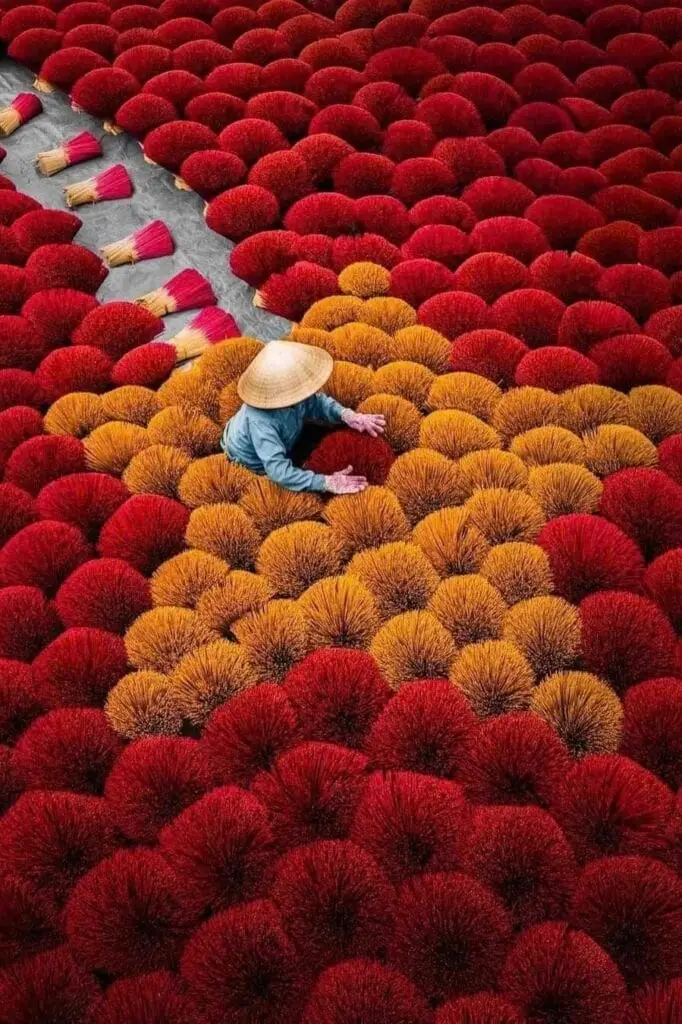
Quang Phu Cau incense village attracts visitors thanks to its vibrant and unique beauty, which is rarely found in the suburban areas of Hanoi. When coming here, visitors will admire thousands of bright red incense bundles that are dried and arranged in circular shapes, creating a lively scene like an artistic painting.
Not only is it a place that preserves a traditional craft village in Hanoi for more than a hundred years, but Quang Phu Cau also offers a unique cultural experience—where you can directly observe the manual incense-making process, talk with local villagers, and feel the diligence and skillfulness in every step.
It is the combination of labor beauty, vibrant colors, and a peaceful atmosphere that makes this place an ideal destination for those who love culture, as well as photographers looking for unique, artistic, and emotional photo angles.


3. History and Culture
3.1. Why Does Quang Phu Cau Make Incense? – The Legend of Xa Cau Village
According to the village elders, this land was once called Xa Cau Trai. Legend says that long ago, three sisters who were brave female generals named Chieu Nuong came here to stay. They were loyal soldiers of the Trung Sisters after fighting against Ma Vien’s army from the Chinese Han Dynasty.
While living with the locals, the three women were protected and loved by the villagers. In return, they helped the people store food, make weapons, and build a peaceful life. Most importantly, they taught the villagers how to make black incense—a simple but sacred type of incense that is very important to Vietnamese spiritual life.
After the three generals passed away, the people of Xa Cau honored them as the Guardian Gods of the village. They built a temple to remember their great work (in Vietnamese culture, these are spirits or historical figures who protect a village, and people worship them in a communal house or temple).
That temple, now called Lang Ca Temple, still stands quietly in the village today. It is a witness to history, the century-old incense craft, and the beautiful Vietnamese tradition: “When drinking water, remember the source” (always be grateful to those who came before us).
At the beginning, incense making was just a side job for farmers during their free time. However, because the local people are very skillful and have secret recipes that create a unique scent, their products became famous. Over time, incense making turned from a part-time job into the main business that supports the whole village.

3.2. The Significance of Incense in Vietnamese Culture
In Vietnamese spiritual culture, burning incense is not only a solemn ritual but also a deeply meaningful spiritual practice.
Thousands of years ago, when humans discovered fire, they started burning woods such as cinnamon, agarwood, or pine to stay warm. They realized these woods produced a very pleasant smell that helped them relax. Moreover, they saw that smoke always rises to the sky. This led people to believe that smoke is a bridge used to send prayers to their ancestors and gods. Besides spiritual reasons, incense smoke also helps remove bad smells, clean the air, and keep insects away.
Inheriting that concept, the incense sticks on the ancestral altar today are a delicate combination of two elements: Fire and Wood. Wood, coming from Mother Earth, combines with the warm flame (Fire), symbolizing the continuous movement and balance of the universe. When the incense is lit, the light smoke rises, acting as a strong “spiritual bridge,” carrying prayers, gratitude, and emotions from descendants across space to reach the sacred world of their ancestors.
Besides its connecting meaning, the gentle scent of incense is also like a medicine for the soul, helping reduce stress and bringing people into a state of calmness, meditation, and deep concentration. From a life perspective, natural incense smoke is also considered a source of pure energy, helping to purify the space, ward off negative things, and create a peaceful and warm atmosphere for every family.
4. Things to do at Incense Village
4.1. Visiting the Quang Phu Cau Village Temple
The journey usually begins at the village temple, which is the center of religious and cultural beliefs of the local people. Here, visitors can admire the ancient architecture typical of the Northern Delta region and listen to stories about the origin of the craft village, as well as the spiritual beauty associated with the traditional incense burning practice that has been preserved for generations.

4.2. Admiring and Taking Artistic Photos at the Incense Drying Yard
The most impressive highlight of Quang Phu Cau incense village is the large drying yards filled with bundles of incense sticks in bright red and pink colors. Local people skillfully arrange them into artistic shapes such as the Vietnamese flag, the map of Vietnam, or giant blooming flowers. This is the perfect place for visitors to freely take creative and culturally rich photos.

4.3. Participating in an Incense-Making Workshop in Quang Phu Cau
To truly understand the craft, visitors can directly join an incense-making workshop in Quang Phu Cau. You will personally experience traditional manual steps such as splitting bamboo, shaping sticks, dyeing the incense base, and drying them.
At the same time, you can observe how locals use modern machinery in incense making, thereby clearly seeing the interaction between traditional and modern methods.


4.4. Strolling Around the Village and Observing Daily Life
Leaving the busy photo areas, visitors can slowly walk through small alleys to feel the real rhythm of life in the village. Along the way, you will easily see artisans carefully bundling incense, preparing bamboo, and working diligently. The natural scent of materials spreads in the air, creating a very special atmosphere.
This is also a great opportunity to talk directly with local people and learn more about their hardworking lifestyle.


4.5. Traditional Cooking Class at Mrs. Vui’s Old House
A perfect way to end your trip is joining a cooking class at Mrs. Vui’s traditional old house. In a simple and rustic space, visitors will learn how to make Vietnamese fresh spring rolls.
Under her detailed guidance, you will prepare ingredients such as pork, herbs, lettuce, and rice noodles, then roll them carefully. After that, everyone will sit together and enjoy the food they made, creating a warm and meaningful cultural experience.


5. How to Get to Quang Phu Cau Incense Village and Local Tips
If you are wondering how far from Hanoi to incense village, it is about 35–40 km south of the city center. There are several ways to travel depending on your budget and preference:
5.1. By Motorbike (Self-driving)
This is a flexible and popular option for young travelers and international visitors who enjoy exploring. Suggested route: from the city center, go along Ton Duc Thang → Nguyen Luong Bang → Tay Son → Nguyen Trai, then continue through Ha Dong area (Tran Phu → Quang Trung) to Ba La intersection. From there, turn left onto National Road 21B and continue straight for about 20 km.
When reaching Quang Phu Cau, you will easily recognize the colorful incense drying yards along both sides of the road.
Travel time is about 1–1.5 hours, with a cost of around 150,000–220,000 VND for motorbike rental and fuel.
Important note: Roads like Nguyen Trai and Quang Trung are often crowded during rush hours. National Road 21B is quite narrow and has many trucks and buses, so you should drive carefully. It is recommended to use Google Maps for easier navigation.
5.2. By Taxi or Ride-hailing Services
This option is suitable for groups of 2–4 people, families, or visitors who prefer comfort. Travel time is about 1 hour, and drivers usually take National Road 21B or the Phap Van – Cau Gie expressway before turning into connecting roads.
- One-way price: 350,000–500,000 VND
- Round trip (including 2–3 hours waiting): 700,000–900,000 VND
Note: If using ride-hailing services, you should arrange a return trip in advance or ask the driver to wait, because it is quite difficult to find a ride back from the village.
5.3. By Bus (Public Transport)
This is the most budget-friendly option and allows you to experience local transportation.
- Step 1: From the city center, go to Yen Nghia Bus Station by Cat Linh – Ha Dong Metro (about 25 minutes, ~15,000 VND) or city buses such as 01, 02, 21A, 27 (45–60 minutes, ~7,000 VND).
- Step 2: From Yen Nghia, take bus 91 to Phu Tuc, and get off at Quang Phu Cau Post Office or Vac intersection (45–60 minutes, ~10,000 VND).
Total cost is only about 15,000–23,000 VND per trip.
Note: From the bus stop, you may need to walk or take a short motorbike taxi (10,000–20,000 VND) to reach the main incense drying yards inside the village. Also, the last bus (route 91) usually ends quite early, around 18:00–18:30, so you should plan your visit time carefully.
More than just a place to visit, Quang Phu Cau is where every incense stick carries a story of heritage, devotion, and quiet beauty—an experience worth discovering for yourself when you step beyond Hanoi.
-The Hanoi Artisan