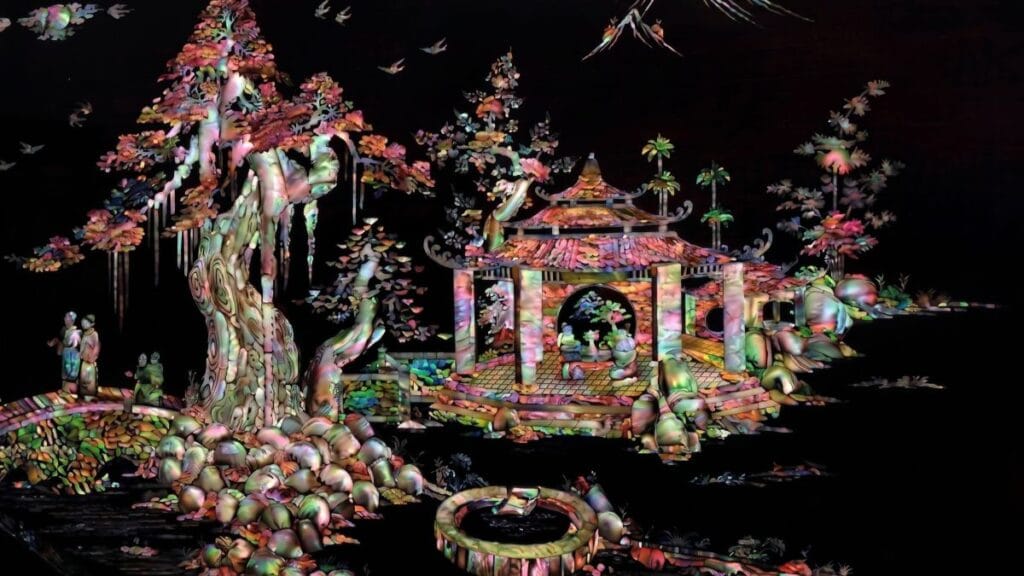
Chuon Ngo Mother-of-Pearl Inlay Village: A thousand years preserving the essence of tradition. Chuon Ngo village (Chuyen My commune, Hanoi) is the cradle of the thousand-year-old art of mother-of-pearl inlay. Since the Ly Dynasty in the 11th century, the sounds of chisels and saws have echoed here, persistently creating masterpieces from shimmering, colorful seashells and snail shells.
Other craft villages in the artisan’s journey:
1. Introduction to Chuon Ngo Mother-of-Pearl Inlay Village
Chuon Ngo Mother-of-Pearl Inlay Village is nestled in the long-standing cultural flow of the Northern Delta, about 40km from the center of Hanoi. With a history of more than 1,000 years, this place is considered the cradle of traditional Vietnamese inlay art—a craft that requires extreme sophistication, patience, and a high sense of aesthetics.
Hanoi countryside village – Chuon Ngo Mother-of-Pearl Inlay Village
Coming to Chuon Ngo, visitors do not simply visit a craft village, but also step into a nostalgic and peaceful space. The sound of chisels and grinding gently echoes in small houses; the sweet scent of wood spreads in the air; and above all is the image of the skillful and meticulous hands of artisans, quickly grafting each shimmering piece of shell into works full of Vietnamese soul. It is the intersection between tradition and authentic emotions that makes Chuon Ngo one of the most special Hidden gems Hanoi has to offer for those who want to find slowness and cultural depth. This is a perfect choice for a countryside day trip from Hanoi and a meaningful Hanoi village trip
2.History & Culture of Chuon Ngo Village – The Soul of the Craft
2.1. Chuon Ngo village history
According to legend, the art of mother-of-pearl inlay in Chuyen My was taught to the villagers of Chuon Ngo by Truong Cong Thanh, a general during the Ly Dynasty. Elderly villagers recount that after achieving many victories, he requested to resign from his official position and return to Chuon Ngo to enjoy his old age. While strolling along the seashore, he was captivated by the shimmering, multicolored beauty of clam and snail shells. He gazed at them intently, then collected them and meticulously pieced them together into shapes and letters. After researching in books, he discovered it was mother-of-pearl inlay.
During a leisurely moment, noticing the many layers of mother-of-pearl with their various colors and beautiful, jade-like sheen, he tried incorporating them into a lacquered couplet with old brown characters, finding it very beautiful. He continued to collect more mother-of-pearl from the sea and created a horizontal plaque and a couplet. The art of mother-of-pearl inlay was thus established. In 1099, before his death, Truong Cong Thanh passed on the craft to the people of Ngo village. Since then, the craft has continued to develop and spread widely, bringing prosperity for generations. Today, the people of Chuyen My worship him as the Village Guardian Deity and the Ancestor of the Mother-of-Pearl Inlay Craft.

2.2. The Artisan’s Story
In Chuon Ngo Mother-of-Pearl Inlay Village, many artisans still tell a simple but very true story about their profession. An elderly artisan once said: “Once, I made a painting of a countryside scene—with a banyan tree, a boat wharf, and a small boat. A foreign guest looked at it for a long time and asked me: ‘How can you put an entire memory into such a small piece of wood?’ At that moment, I realized that what I am doing is not just making handicrafts, but preserving the memories of an entire countryside.”
He added: “Inlay is not just about cutting shells and putting them together. Each piece must be chosen for the right thickness, the right luster, and placed in the right spot for it to have ‘soul’. The maker must understand the story they are telling for the product to live long.” For the craftsmen here, each product is a way to preserve culture—from images of the village to ancient legends. Therefore, the greatest value of this Hanoi village craft lies in the soul that the artisan puts into every tiny detail.
3. What to See and Do: Things to do in Chuon Ngo Village
3.1. Chuon Ngo Product Exhibition Center
If you want to fully feel the essence of the village, the Exhibition Center is a stop you should not miss. This is the place that gives you the clearest view of the finished beauty of the works—from the delicately polished surfaces to the smallest details handled with amazing precision, revealing the meticulousness behind each piece. Standing before these products, you will be able to admire the traditional aesthetic beauty that has been passed down through many generations.. This experience is a highlight of any Mother-of-Pearl Inlay Village.
3.2. Chuon Ngo Communal House
Chuon Ngo Communal House is not only a spiritual center but also a place that keeps the historical pride of the villagers. Inside, the horizontal plaques and couplets tell the story of a land attached to the craft. Especially, a plaque with the inscription: “The people of Ngo village are always grateful to this sacred land for giving us a prosperous life thanks to the traditional craft of our ancestors and vow to develop it forever” stands out as a symbol of gratitude to the ancestor Truong Cong Thanh.nor the heritage of the Ancestor, Truong Cong Thanh.

3.3. Chuon Ngo Mother-of-Pearl Mosaic Church
Chuon Ngo Mother-of-Pearl Mosaic Church is a vivid testament to the unique cultural fusion in the mother-of-pearl mosaic village. Inside the church’s solemn space, mother-of-pearl mosaic paintings depict familiar images of Catholicism such as Jesus, the Virgin Mary, and biblical stories, but rendered using traditional Vietnamese craftsmanship. The shimmering mother-of-pearl not only highlights the details but also creates a beauty that is both sacred and intimate.
The combination of traditional mother-of-pearl mosaic art and Catholic symbolism has created a space that both bears the imprint of local culture and reflects the harmonious integration of different values—where the craft becomes a bridge between faith and village identity.


3.4. Hands-on Mother-of-Pearl Inlay Workshop with Artisan Nguyen Van Dung
At the workshop of artisan Dung, everything becomes much more real. Small pieces of shell are cut, ground, and assembled entirely by hand with absolute patience. When observing this process, you will change the way you look at finished products—they become the crystallization of time and effort. You will also have the opportunity to directly experience a step in the process under his guidance in an exclusive Mother-of-Pearl Inlay Workshop.


3.5. Local Family Home & Cooking Experience
This experience brings a close and authentic feeling to your Hanoi village trip. At the home of Mr. Ngoc Anh, you will be welcomed like an old friend. You will join the host to prepare Pho Cuon—a simple dish that connects people. There is no rush; everything happens naturally through the stories shared. It is a moment where the boundary between “tourist” and “host” disappears, leaving you with the feeling of truly living in the rhythm of Chuon Ngo people.


4. How to get to Chuon Ngo Village
Chuon Ngo Mother-of-Pearl Inlay Village is located about 40km south of Hanoi city center, making it quite convenient for a Hanoi countryside village with many different options:
Bus: From the Old Quarter, take a taxi to Giap Bat station and take bus No. 06 (Giap Bat – Phu Ly). After about 1–1.5 hours, get off near Phu Xuyen town. From there, it is just a short 5–7 km taxi or motorbike ride to the village. This is an affordable and straightforward option.
Motorbike: A “local” experience, costing around 80,000 VND to 160,000 VND per day. From Hanoi center, you can go towards National Highway 1A or the Phap Van – Cau Gie highway. The journey takes about 1–1.5 hours and the road is quite easy to go. Check the map: Use Google Maps to find the best route if driving yourself.
Taxi/Ride-hailing: This is the most convenient way if you travel in a group. Just enter “Chuon Ngo” into the app, and you will be taken directly to the village.
In Chuon Ngo, the beauty of the craft lies not only in the shimmering colors of the sea, but in the silent patience of an artisan who transforms a simple shell into a thousand-year-old story.
-The Hanoi Artisan!